Iranian Barrage Hits Tel Aviv Again As Building Collapses And Citywide Power Outage Spreads
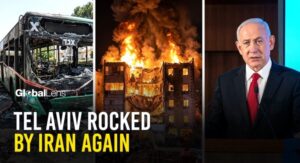
In recent days, the situation has continued to intensify with multiple reports describing Iranian projectiles heading toward the Tel Aviv area and central Israel once again experiencing visible damage, emergency mobilization, and repeated disruption to civilian life. What many hoped would become a fragile diplomatic pause now appears increasingly uncertain as each new alert raises fresh questions about whether deescalation is truly taking hold.
The latest developments reinforce the growing view that Tel Aviv and surrounding areas remain under sustained pressure with little indication that the confrontation is genuinely slowing down. All of this is unfolding at a moment when wider diplomatic efforts were expected to deliver at least a temporary easing of tensions.
According to the latest reporting, Benjamin Netanyahu remains prime minister of Israel and his government has signaled support for the US backed pause framework, but only under strict conditions tied to Iran halting hostile activity and ensuring maritime access through the Strait of Hormuz. Across Tel Aviv and nearby parts of central Israel, the latest alerts and reported impacts have deepened a pattern residents now know all too well.
Sirens can sound without warning. Families rush for shelter. Interceptors light up the night sky. And then comes the hardest part, the uncertainty that follows. Even when the first wave appears to be over, the danger may not be gone. Falling debris, direct impacts, or scattered submunitions can still pose serious risks.
Earlier visuals from March showed civilians running for cover in Tel Aviv, visible damage across central Israel, and projectiles described as carrying cluster style munitions toward populated areas. Those scenes now appear to be part of a wider and increasingly troubling pattern that is unfolding once again. The phrase a Tel Aviv burns is highly dramatic and should be handled carefully.
But the broader confirmed reality is that central Israel has experienced repeated visible damage in recent weeks, including fires, crater sites, damaged residential buildings, and major emergency responses. On March 26th, reports indicated that at least one ballistic missile reached Tel Aviv, while other projectiles were described as carrying cluster style munitions that release smaller submunitions, damaging homes and vehicles.
That distinction matters because cluster type payloads widen the danger zone and extend the risk even after the initial interception phase appears to be over. Israeli media and regional reporting have repeatedly described recent barges towards central Israel as involving cluster warheads or cluster style munitions.
Tel Aviv, Ramat Gan, Roshayin, Benet Brock and nearby areas have all been mentioned in connection with alerts, impacts or visible damage. One report citing Israeli media said Iran launched at least 10 missiles with cluster warheads across three separate waves targeting central Israel in recent days. In fast-moving situations like this, exact figures should always be treated with caution, but the broader pattern remains consistent across multiple reports.
Cluster type munitions have become a defining feature of the recent Iranian barges. A missile carrying a conventional warhead creates one immediate danger zone. A missile carrying submunitions can create multiple smaller danger points across neighborhoods, rooftops, roads, vehicles, and open areas.
That changes the experience entirely. It means the threat can continue even after the first interception. It means residents cannot assume the danger is over once the initial blast or intercept has passed. That is why every new siren in the Tel Aviv region now brings a deeper sense of anxiety. Even after interceptions, civilians are often told to remain alert, stay undercover, and wait for official clearance before moving.
This confrontation is no longer only about military signaling or strategic calculations. It is also about endurance. It is about which side can absorb sustained pressure, which side can maintain public confidence, and which side can continue projecting control under repeated strain. In Israel, repeated alarms in the Tel Aviv region challenge the image of total defensive certainty.
This phase has increasingly been described as one in which Iranian missiles are testing Israel’s layered air defense systems with some projectiles reportedly getting through and causing damage. That does not mean Israel’s defensive network has collapsed, but it does show that even advanced systems can be stretched under repeated salvos and prolonged pressure.
Thrron does not need every missile to land directly to send its message. It only needs enough visible pressure to show that Israel’s central urban core remains vulnerable. That is why Tel Aviv carries such symbolic importance in this confrontation. It is not simply a city under pressure.
It has become the image of Israeli resilience being tested in real time. Every siren, every rush to shelters, every visible interception over the skyline becomes part of that message. Netanyahu’s government has continued to make clear that it is not stepping away from its broader security objectives even while accepting a USbacked pause framework.
Through March and into April, Israeli officials have tied support for pauses or deescalation to strict conditions. Netanyahu has continued to frame this confrontation as part of a much wider strategic effort aimed at weakening Iran’s military infrastructure and missile capabilities. That means Israel is trying to send two messages at once.
First, that it is open to a temporary pause under the right conditions, and second, that it remains fully prepared to continue its wider campaign if those conditions are not met. If a pause is being discussed and fresh missile activity still follows, both sides immediately move into a political blame contest. Who violated the spirit of the arrangement first? Who is escalating? Was the ceasefire ever truly real in practical terms? Or was it simply a diplomatic announcement with no effective control on the ground? Those questions matter because they shape what
happens next. They influence whether diplomacy survives even a few more days. They affect whether Washington decides to harden its posture and they help determine whether Israel expands its response. Under President Donald Trump, the United States has become central to both the pressure campaign and the pause effort.
This week, Trump agreed to a 2-week ceasefire arrangement after intense diplomatic pressure and mediation efforts, including a request from Pakistan’s Prime Minister Shabbaz Sharif for time to allow diplomacy a chance. But before that pause began to take shape, Trump had also issued strong warnings and signaled readiness to escalate if no agreement emerged.
So the pause should not be seen as proof that the crisis is over. It is better understood as a narrow diplomatic bridge built over an active and highly unstable line of confrontation. Each new barrage now carries consequences far beyond the immediate moment. It can influence negotiations. It can affect US posture.
It can strengthen or weaken Israeli political messaging. And it can reshape how regional players calculate the next 24 to 48 hours. A single barrage is no longer just a military event. It becomes a political signal, a diplomatic test, and a regional message all at once. Over the past month, images from central Israel have shown people leaving homes, gathering near damaged buildings, watching smoke rise after impacts, and waiting for emergency teams to clear affected areas.
These are not abstract scenes. They show how repeated barges turn daily life into a cycle of alarms, waiting, uncertainty, and recovery. For residents in and around Tel Aviv, every alert disrupts the rhythm of ordinary life. Streets empty, shelters fill, families pause everything, businesses stop, traffic patterns shift, and even when the immediate danger passes, the emotional burden remains.